Introduction to Microbial Whole Genome Sequencing


Microbial Whole Genome Sequencing is a technique used to sequence the entire genome of a microbe. Sequencing bacterial, fungal, or other microbial genomes is important for the generation of accurate reference genomes, new microbial species discovery, as well as for comparative genomic studies. Compared to conventional approaches such as PCR, Microbial Whole Genome Sequencing is time- and cost effective as it does not require labour-intensive cloning and mapping steps. It is also a high-throughput sequencing approach as it allows the sequencing of numerous samples at the same time.
Novogene Europe has extensive experience with microbial Whole Genome Sequencing for a wide variety of microbial species. We provide microbial whole genome resequencing service, with the choice of either long read or short read sequencing strategy depending on the research objective. Our service is complete with high-quality data, bioinformatics analysis to assist with data interpretation and “publication-ready’’ figures accompanying the analysis. Microbial whole genome resequencing has a wide range of applications across multiple fields, including healthcare, biotechnology, evolutionary biology, food science, and environmental science research.
Applications of Microbial Whole Genome Sequencing
Microbial Whole Genome Sequencing has been assisting researchers in the following research areas, including:
- Food safety and environmental research
- Antimicrobial resistance genes and mechanisms
- Evolutionary biology and ecology
- Vaccine development and clinical diagnosis studies
If you are instead interested in applications requiring de novo sequencing of microbial species, please refer here.
Benefits of Novogene’s Microbial Whole Genome Sequencing service
- Extensive Experience: We have successfully completed high-profile projects which cover a wide range of fields such as pathogenic bacteria, probiotics, edible bacteria, medicinal strains, and industrial strains.
- High-Quality Data: We deliver high-quality sequencing data that meets leading industry standards.
- Bioinformatics Support: We provide comprehensive bioinformatics analysis, complete with ‘publication ready’ figures, with insights into the different variant types.
- Short Read and Long Read Sequencing: Novogene offers you with the option of carrying out resequencing of microbial samples with short read and long read sequencing strategies, depending on the type of variants of interest to you.
- Fast Turnaround Times: Our sequencing labs are located near you, in Germany and the UK, allowing for reduced shipping times. With our large sequencing capacity, automated and streamlined workflows, we ensure that you receive your data promptly without compromising on quality
- Customer Service System (CSS): Novogene’s Customer Self Service System (CSS) is an online project management portal that streamlines project management and provides direct access to all your sequencing projects in one place. You can view your sequencing project(s), track their progress, access reports, collaborate with your team members, and obtain other useful information at one place
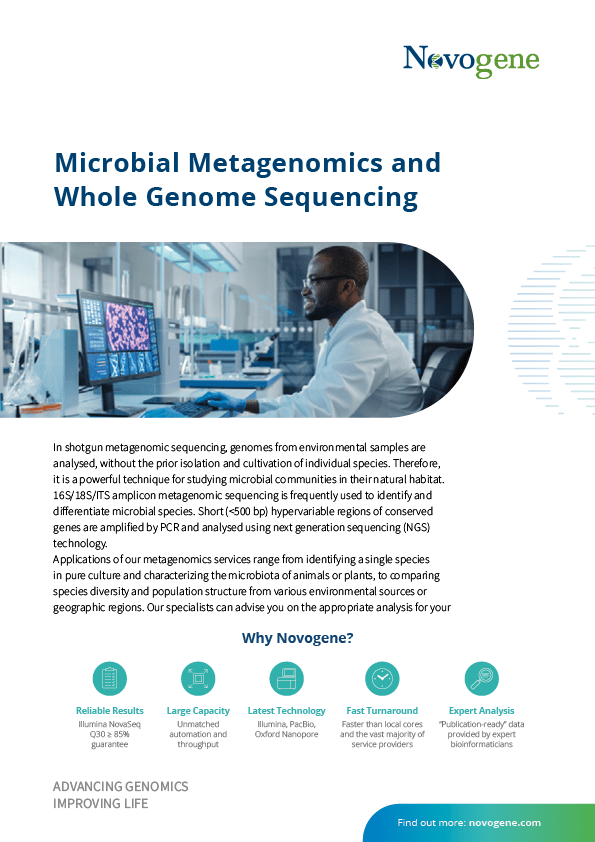
Microbial Metagenomics and Whole Genome Sequencing Service Flyer
In shotgun metagenomic sequencing, genomes from environmental samples are analysed, without the prior isolation and cultivation of individual species. Therefore, it is a powerful technique for studying microbial communities in their natural habitat. 16S/18S/ITS amplicon metagenomic sequencing is frequently used to identify and differentiate microbial species. Short (<500 bp) hypervariable regions of conserved genes are amplified by PCR and analysed using next generation sequencing (NGS) technology.
On-demand Webinar
Unfolding the Microbial World: A Journey through Sequencing Applications
The microbial world is teeming with an estimated one trillion species, only a fraction of which, approximately 155,000, have been sequenced so far. For researchers interested in the microbiome, the advent of next-generation sequencing (NGS) technologies and advanced data analysis methods presents an unparalleled opportunity to delve deeper into the intricacies of the microbial universe – whether you are interested in a single species or a microbial community. NGS serves as a pivotal tool, allowing us to dissect microbial communities, unravelling their complexities and unveiling their profound impact on diverse ecosystems.
In this webinar we will talk about myriad microbial sequencing options such as microbial whole genome sequencing, metagenomics, and metatranscriptomics. We will also discuss recent advances in the field such as the applications of long-read sequencing and highlight Novogene’s diverse microbial sequencing solutions to aid your research.
Learning Objectives:
- Explore sequencing options for individual microbial species or communities
- Discover recent advances in microbial sequencing technologies
- Understand workflow and analysis pipelines for microbial sequencing.
Microbial Whole Genome Sequencing Specifications: DNA Sample Requirements
| Service | Sample Type | Amount (Qubit®) | Volume | Concentration | Purity (NanoDrop™/Agarose Gel) |
| Microbial WGS | Genomic DNA/total DNA* | ≥100 ng | ≥20 μL | ≥5 ng/μL | OD260/280 = 1.8-2.0; no degradation, no contamination Fragments longer than 1000 bp |
| PCR-free WGS | Genomic DNA /total DNA | ≥1.2 μg | ≥20 μL | ≥20 ng/μL | OD260/280 = 1.8-2.0; no degradation, no contamination |
*Total DNA includes all types of DNA present in a sample, including genomic DNA, mitochondrial DNA and any other extrachromosomal DNA.
Novogene Workflow of Microbial Whole Genome Sequencing Service
The first step of the project workflow involves the sample quality control (Sample QC) to ensure that your samples meet the criteria of the Microbial WGS technique. Then, the appropriate library is prepared according to your target organism and subsequently tested for its quality (Library QC). Next, a paired-end 150 bp sequencing strategy is used to sequence the samples and the resulting data go through quality data control (Data QC) to guarantee the quality of the resulting data. Finally, bioinformatics analyses are performed and publication-ready results are provided. The following flowsheet describes the step-by-step protocol our Microbial WGS technique follows.
Preparation of sample is followed by the DNA library preparation which is verified for quality and yield. Genomic DNA is fragmented with a size of 350 bp which is narrowly size selected by sample purification beads. The selected fragments are then end polished, A-tailed, and ligated with the full-length adapter. Illumina PE150 technology is employed to sequence the sample and the final stage involves the bioinformatics analysis.


Featured Publications of Microbial Whole Genome Sequencing
-
Exploring the host range for genetic transfer of magnetic organelle biosynthesis
Nature NanotechnologyIssue Date: 21 September 2023IF: 38.3DOI: 10.1038/s41565-023-01500-5
-
(p)ppGpp modifies RNAP function to confer β-lactam resistance in a peptidoglycan-independent manner
Nature MicrobiologyIssue Date: 4 March 2024IF: 28.3DOI: 10.1038/s41564-024-01609-w
-
Assessing microbiome population dynamics using wild-type isogenic standardized hybrid (WISH)-tags
Nature MicrobiologyIssue Date: 19 March 2024IF: 28.3DOI: 10.1038/s41564-024-01634-9
-
NUCLEIC ACIDS RESEARCHIssue Date: 11 January 2023IF: 19.16DOI: 10.1093/nar/gkac1197
-
Structural insights into the iron nitrogenase complex
NATURE STRUCTURAL & MOLECULAR BIOLOGYIssue Date: 7 December 2023IF: 16.8DOI: 10.1038/s41594-023-01124-2
-
Nature CommunicationsIssue Date: 17 November 2023IF: 16.6DOI: 10.1038/s41467-023-43241-y
-
Dynamics and Microevolution of Vibrio parahaemolyticus Populations in Shellfish Farms
mSystems Date: 12 January 2021IF: 6.663DOI: https://doi.org/10.1128/mSystems.01161-20
-
Science of the Total Environment Date: 20 june 2021IF:6.551DOI: https://10.1016/j.scitotenv.2021.145767
-
food chemistry Date: 15 November 2020IF: 6.306DOI: https://10.1016/j.foodchem.2020.127316
-
Whole genome sequence of Diaporthe capsici, a new pathogen of walnut blight
Genomics Date: 23 February 2021IF: 6.205DOI: https://doi.org/10.1016/j.ygeno.2020.04.018
-
Effect of steel slag in recycling waste activated sludge to produce anaerobic granular sludge
Chemosphere Date: 25 October 2020IF: 5.108DOI: https://doi.org/10.1016/j.chemosphere.2020.127291
-
Journal of Global Antimicrobial Resistance Date: 23 December 2020IF: 4.035DOI: https://10.1016/j.jgar.2020.08.002
-
Alterations of gut microbiota contribute to the progression of unruptured intracranial aneurysms
Nature Communications Date: 25 june 2020IF:14.919DOI: https://10.1038/s41467-020-16990-3
SNP Mutation Frequency
Single nucleotide polymorphism (SNP) refers to a variation in a single nucleotide that can occur at some specific position in the genome, including transition and transversion of a single nucleotide.
Taken the T: A>C: G mutations as an example, this category includes mutations from T to C and A to G. When T>C mutation appears on either of the double-strand, the A>G mutation will be found in the same position of the other chain. Therefore the T>C and A>G mutations are classified into one category. Accordingly, the whole genome SNP mutations could be classified into six categories. The frequency of each type is shown in Figure X.

Note:
The x-axis represents the number of SNPs and the y-axis indicates the mutation types.
Length Distribution of CDS-located InDels
InDel refers to the insertion or deletion of ≤ 50 bp sequences in the DNA. The results demonstrate several peaks present at certain InDel lengths. Non-frameshift InDels exert a smaller effect on the genome as compared to frameshift InDels.

Note:
The x-axis represents the proportion of the InDels with a certain length, and the y-axis indicates the length of the InDels.
Length Distribution of SVs
Structural variants (SVs) are genomic variations with mutations of relatively larger size (>50 bp), including deletions, duplications, insertions, inversions, and balanced translocations.

Note:
The x-axis represents the proportion of the SVs with a certain length range, and the y-axis indicates the certain length range of the SVs. Note, the length of DNA insert in library construction impacts the SVs detection greatly.
The distribution of CNVs on the genome
Copy-number variation (CNV) is a type of structural variation that happens when a DNA fragment is present in variable copy number in comparison to a reference genome. It pinpoints the deletions and duplications in the genome.

Note:
The x-axis represents samples and the y-axis indicates the number of CNVs in a different region.
Visualization of Variation
For proper visualization of the structural variations in the whole genome, we present mutation types with Circos:
(1) for SNP/InDel type, the density distribution is drawn;
(2) for SV/CNV type, the location and size are drawn.

Note :
From outer to inner: chromosome, SNP, InDel, CNV duplication, CNV deletion, SV insertion, SV deletion, SV invertion, SV ITX, SV CTX.
*Please contact us to get the full demo report.
