Introduction to Prokaryotic RNA Sequencing


Prokaryotic RNA sequencing utilizes next-generation high-throughput sequencing (NGS) technology to sequence the prokaryotic transcriptome and quickly and systematically procure data of all transcripts (coding and non-coding mRNA).
Prokaryotic RNA sequencing profiles the transcriptome through a stranded RNA library, delivering a more accurate estimation of transcript expression.
Application of Prokaryotic RNA Sequencing
- Profiling transcripts in prokaryotes
- Predicting operon, TSS, promoter, and UTR
- Exploring RNA regulation mechanism through antisense transcripts prediction and sRNA analysis
Benefits of Novogene Prokaryotic RNA Sequencing
- Novogene adopted rRNA depletion methods for the construction of prokaryotic RNA libraries. Effective depletion methods were adopted for a variety of species.
- Besides gene expression quantification, multiple gene structure and gene function analysis are included in the standard analysis. Customized analyses can also be devised for prokaryotic RNA sequencing.
- Quick shipment to our UK or German lab.
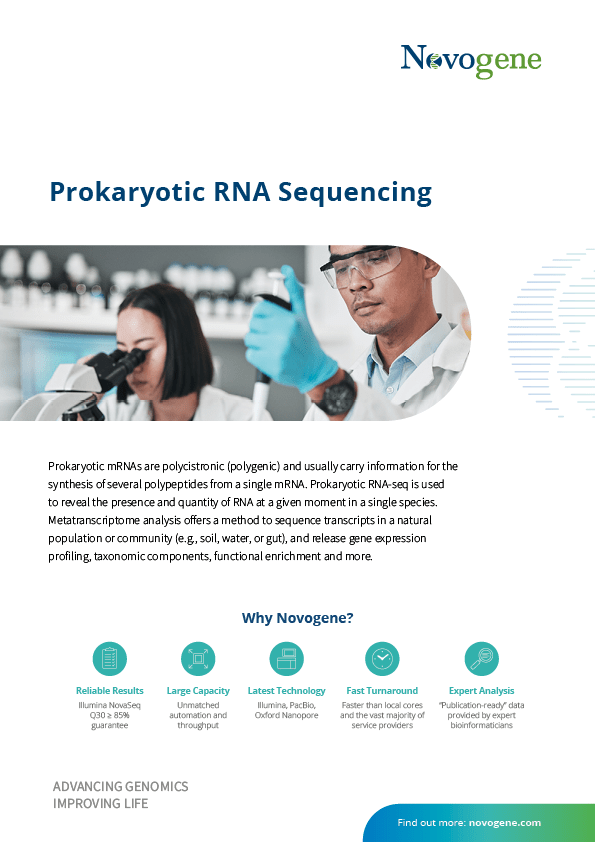
Prokaryotic RNA Sequencing Service Flyer
Prokaryotic mRNAs are polycistronic (polygenic) and usually carry information for the synthesis of several polypeptides from a single mRNA. Prokaryotic RNA-seq is used to reveal the presence and quantity of RNA at a given moment in a single species. Metatranscriptome analysis offers a method to sequence transcripts in a natural population or community (e.g., soil, water, or gut), and release gene expression profiling, taxonomic components, functional enrichment and more.
On-demand Webinar
Unfolding the Microbial World: A Journey through Sequencing Applications
The microbial world is teeming with an estimated one trillion species, only a fraction of which, approximately 155,000, have been sequenced so far. For researchers interested in the microbiome, the advent of next-generation sequencing (NGS) technologies and advanced data analysis methods presents an unparalleled opportunity to delve deeper into the intricacies of the microbial universe – whether you are interested in a single species or a microbial community. NGS serves as a pivotal tool, allowing us to dissect microbial communities, unravelling their complexities and unveiling their profound impact on diverse ecosystems.
In this webinar we will talk about myriad microbial sequencing options such as microbial whole genome sequencing, metagenomics, and metatranscriptomics. We will also discuss recent advances in the field such as the applications of long-read sequencing and highlight Novogene’s diverse microbial sequencing solutions to aid your research.
Learning Objectives:
- Explore sequencing options for individual microbial species or communities
- Discover recent advances in microbial sequencing technologies
- Understand workflow and analysis pipelines for microbial sequencing.

Prokaryotic RNA-seq Specifications: RNA Sample Requirements
| Library Type | Sample Type | Amount | RNA Integrity Number (Agilent 2100) |
Purity (NanoDrop) |
| Prokaryotic RNA Library | Total RNA | ≥ 500 ng | ≥ 6.0, smooth base line | A260/280 ≥ 2.0;
A260/230 ≥ 2.0 |
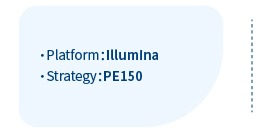
Prokaryotic RNA -seq Specifications:Sequencing and Analysis
| Sequencing Platform | Illumina NovaSeq X Plus Sequencing System |
| Read Length | Paired-end 150bp |
| Recommended Data Amount | ≥ 2Gb raw data per sample for the species with reference genome |
| Content of Data Analysis |
|
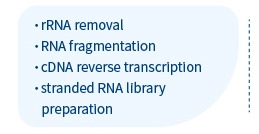
Novogene Workflow of Prokaryotic RNA -seq Service
The first step of the project workflow includes sample quality control (Sample QC) to ensure that your samples meet the criteria of the RNA-Seq technique. Then, an appropriate library is constructed according to your target organism and subsequently tested for its quality (Library QC). Next, a paired-end 150 bp sequencing strategy is used to sequence the samples, and the resulting data goes through quality data control (Data QC) to guarantee the quality of the resulting data. Finally, bioinformatic analyses are performed and publication-ready results are provided. The following flowsheet elaborates the step-by-step protocol.

-
SlyB encapsulates outer membrane proteins in stress-induced lipid nanodomains
NATUREIssue Date: 11 December 2023IF: 64.8DOI: 10.1038/s41586-023-06925-5
-
Profiling of the Helicobacter pylori redox switch HP1021 regulon using a multi-omics approach
Nature CommunicationsIssue Date: 23 October 2023IF: 16.6DOI: 10.1038/s41467-023-42364-6
-
PLANT CELLIssue Date: 24 November 2023IF: 11.6DOI: 10.1093/plcell/koad292
-
ISME JournalIssue Date: 10 January 2024IF: 11DOI: 10.1093/ismejo/wrad001
-
Plasmids manipulate bacterial behaviour through translational regulatory crosstalk
PLOS BIOLOGYIssue Date: 14 February 2023IF: 9.593DOI: 10.1371/journal.pbio.3001988
-
A Deep-Sea Bacterium Is Capable of Degrading Polyurethane
Microbiology SpectrumIssue Date: 30 March 2023IF: 9.043DOI: 10.1128/spectrum.00073-23
Distributions of gene expression levels
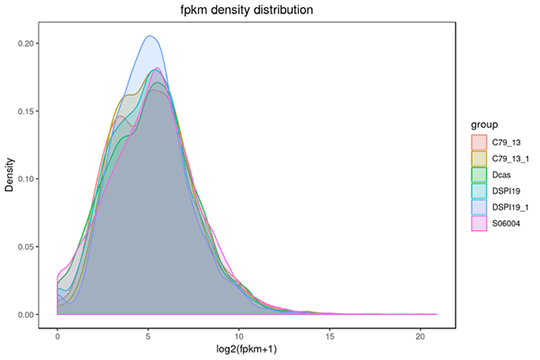
To compare gene expression levels under different conditions, gene expression level and FPKM distribution among different samples are displayed.
Note:
The figure reveals the FPKM density distribution. The x-axis shows the log10(FPKM+1) and the y-axis describes the gene density
Volcano plot for differentially expressed genes
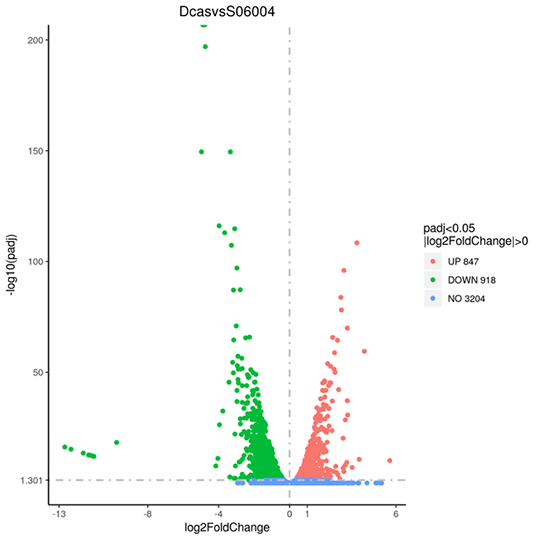
Volcano plots are used to infer the overall distribution of differentially expressed genes.
Note:
Red, and green shows significantly up-, and down-regulated genes, respectively. Blue indicates no significance.
UTR length distributions
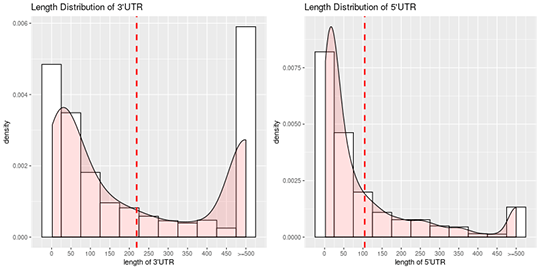
The 5′ and 3′ UTR sequences are extracted based on the start and end positions of both transcription and translation. The length distributions of both 5′ and 3′ UTR sequences are plotted, respectively.
Note:
The x-axis shows the length intervals of UTRs, and the y-axis shows densities of UTRs in different length intervals. The dotted red line describes the averaged length.
*Please contact us to get the full demo report.
