Introduction to Small RNA Sequencing


Small RNAs (sRNAs) are short RNA molecules, usually non-coding, involved with gene silencing and the post-transcriptional regulation of gene expression. sRNA Sequencing (sRNA-seq) is a method that enables the in-depth investigation of these RNAs, in special microRNAs (miRNAs, 18-40nt in length).
Novogene sRNA-seq service is an effective approach to selectively target any species of sRNAs with unprecedented sensitivity and high resolution, all in a single analysis. Coupled with a robust in-house bioinformatics pipeline, Novogene sRNA-seq service has been assisting researchers to describe the differential expression of miRNAs, structural alterations, and to discover novel sRNAs.
Applications of small RNA sequencing
sRNA-seq has been supporting many compelling research avenues, including:
- Profiling known and novel transcripts and expression quantifications of small RNA
- Predicting targeting genes of miRNA candidates
- Identifying tissue, stage, or cell type-specific biomarkers for cancer/disease diagnostics and classification
- Discovering regulatory networks and understanding the mechanisms of tissue or organism development based on transcript profiles
Benefits of Novogene small RNA Sequencing
- The Novogene sRNA-seq is a well-established service that relies on extensive experience, with numerous samples successfully sequenced. It allows access to expression profiles and transcript characterizations for multiple small RNA species, with a tried-and-tested workflow for both input sample of total RNA and exosomal RNA.
- Novogene offers comprehensive analyses using top-notch software and a mature in-house pipeline, meeting all your bioinformatics needs. Researchers can obtain the regulation network, the deep regulation mechanism of gene expression, and more, with Novogene’s high quality services.
- Quick shipment to our UK or German lab.
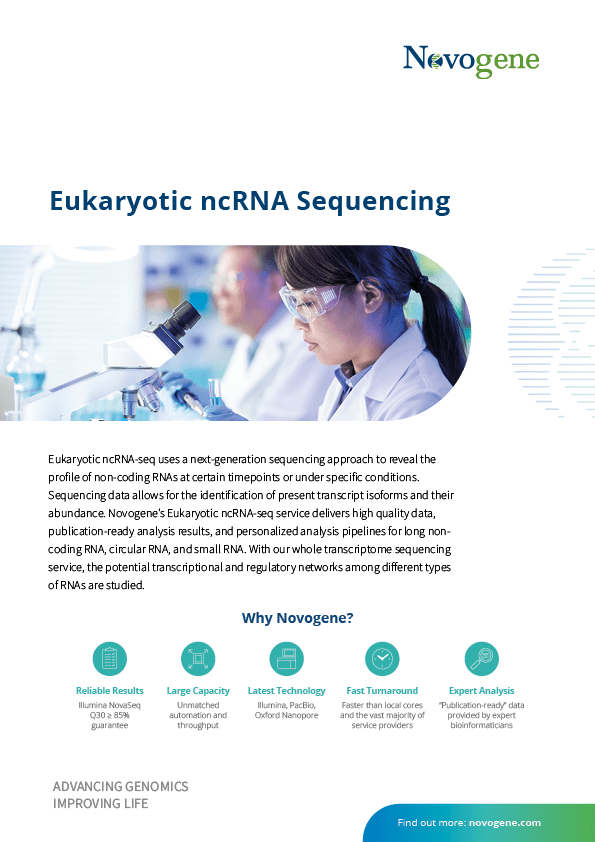
Eukaryotic ncRNA Sequencing Service Flyer
Eukaryotic ncRNA-seq uses a next-generation sequencing approach to reveal the profile of non-coding RNAs at certain timepoints or under specific conditions. Sequencing data allows for the identification of present transcript isoforms and their abundance. Novogene’s Eukaryotic ncRNA-seq service delivers high quality data, publication-ready analysis results, and personalized analysis pipelines for long noncoding RNA, circular RNA, and small RNA. With our whole transcriptome sequencing service, the potential transcriptional and regulatory networks among different types of RNAs are studied.
On-demand Webinar
ncRNA-seq Results Explained: What you can explore with non-coding RNA data
Non-coding RNA-sequencing (ncRNA-seq) is a powerful technique for studying the regulatory functions of different types of ncRNAs in gene expression: from long non-coding RNA sequencing (lncRNA-seq), small RNA sequencing (sRNA-seq) to circular RNA sequencing (circRNA-seq) for diverse eukaryotic species.
The data generated by ncRNA-seq can uncover the gene expression profile of coding and non-coding transcripts and assist in the discovery of novel transcripts, to establish regulation networks among lncRNA, miRNA and circRNA.
However, without a background in bioinformatics, the analysis required can be both challenging and intimidating. In this follow up webinar to our ‘RNA-seq Results Explained’, we provide an overview of the ncRNA-seq analysis workflow, and a walkthrough of the tools and processes used to assess your datasets and meet your research goals.
Learning Objectives:
- Get an overview of ncRNA sequencing approaches
- Learn about ncRNA-seq data evaluation & visualisation
- Get familiar with data handling software and file formats.
sRNA-seq Specifications: RNA Sample Requirements
| Library Type | Sample Type | Amount | RNA Integrity Number (Agilent 2100) | Purity (NanoDrop) |
| Small RNA Library | Total RNA | ≥ 2 μg | Animal ≥ 7.5, Plant ≥ 7, with smooth baseline | A260/280 = 1.8-2.2 A260/230 ≥ 1.8 |
| Exosomal Small RNA Library | Exosomal RNA | ≥ 10 ng | Peak between 25-200 nt, FU> 10, no peak > 2000 nt |
Note: Sample amounts are listed for reference only. Download the Service Specifications or Sample Requirements to learn more. For detailed information, please contact us with your customized inquiry.
sRNA-seq Specifications: Sequencing and Analysis
| Sequencing Platform | Illumina NovaSeq 6000 |
| Read Length | Single-end 50 bp |
| Recommended Sequencing Depth | ≥ 10 million read pair per sample |
| Standard Analysis (miRNA) |
|
Note: Sequencing depths and analysis contents displayed are for reference only. Download the Service Specifications to learn more. For detailed information, please contact us.
Project Workflow of Novogene sRNA-seq Services
The project workflow starts with sample quality control (Sample QC) to ensure that your samples meet the criteria of the sRNA-Seq technique. Then, the appropriate library is prepared according to your target organism and application, and subsequently tested for its quality (Library QC). Next, a single-end 50 bp sequencing strategy is used to sequence the samples and the resulting data is also checked for its quality (Data QC). Finally, bioinformatic analyses are performed and publication-ready results are provided.


Publications
Novogene’s comprehensive sRNA-seq empowers researchers to investigate the differential expression and regulatory network of miRNAs, structural alterations, and to discover novel small RNAs. Here is a list of publications below that have used Novogene’s sRNA-seq services.
-
MTHFD1 is critical for the negative regulation of retinoic acid receptor signalling in anencephaly
BRAINIssue Date: 16 March 2023IF: 15.255DOI: 10.1093/brain/awad084
-
JOURNAL OF HAZARDOUS MATERIALSIssue Date: 23 March 2023IF: 13.6DOI: 10.1016/j.jhazmat.2023.131262
-
Scientific DataIssue Date: 10 June 2023IF: 9.8DOI: 10.1038/s41597-023-02288-8
-
Molecular Therapy-Nucleic AcidsIssue Date: 11 January 2023IF: 8.8DOI: 10.1016/j.omtn.2023.01.004
-
Molecular Ecology ResourcesIssue Date: 15 January 2023IF: 8.678DOI: 10.1111/1755-0998.13750
-
Integrative time-scale and multi-omics analysis of host responses to viroid infection
PLANT CELL AND ENVIRONMENTIssue Date: 28 June 2023IF: 7.3DOI: 10.1111/pce.14647
-
A genomic and epigenomic atlas of prostate cancer in Asian populations
NatureIssue Date: 25 March 2020IF: 42.778DOI: 10.1038/s41586-020-2135-x
-
Spliceosome disassembly factors ILP1 and NTR1 promote miRNA biogenesis in Arabidopsis thaliana
Nucleic Acids ResearchIssue Date: 19 June 2019IF: 11.501DOI: 10.1093/nar/gkz526
sRNA Length Distribution

sRNA Classification-Repeat Sequence

miRNA-structure

miRNA-base bias

TPM Boxplot

TPM Density Distribution

Hierarchical Cluster

More Research Services
