Introduction to Target Region Sequencing


Target Region Sequencing (TRS) is a technique that focuses on sequencing a subset of genes or specific regions of the genome, which are hypothesized to be associated with a certain disease or a phenotype. It is often used to analyse genetic variations in the genes of interest. Compared to Whole Genome Sequencing and Whole Exome Sequencing, target region sequencing generates a more manageable dataset and is cost-effective when investigating regions of interest, thus allowing researchers to sequence at higher depths and identify rare variants.
Novogene has experience with target region sequencing for different genomic regions of interest and subset of genes, using a variety of enrichment panels. We also offer bioinformatics support to assist with data analysis and provide publication-ready figures, accompanying the analysis.
Applications of Target Region Sequencing
TRS is useful in fields such as:
- Cancer research
- Evolutionary biology
- Linkage analysis for inherited diseases
- Detection and quantification of low-frequency alleles and rare variants
- Discovery of biomarkers and therapeutic targets
Benefits of Novogene’s Target Region Sequencing service
- Extensive Experience: Novogene has experience with target region sequencing for different genomic regions of interest and subset of genes, using variety of enrichment panels.
- High-Quality Data: We deliver high-quality sequencing data that meets leading industry standards.
- Bioinformatics Support: We provide comprehensive bioinformatics analysis, complete with ‘publication ready’ figures.
- Short Read and Long Read Sequencing: Novogene provides the option of carrying out your sequencing projects with your choice of sequencing strategy, short read and long read, using the latest sequencing platforms on the market.
- Fast Turnaround Times: Our sequencing labs are located near you, in Germany and the UK, allowing for reduced shipping times. With our large sequencing capacity, automated and streamlined workflows, we ensure that you receive your data promptly without compromising on quality
- Customer Service System (CSS): Novogene’s Customer Self Service System (CSS) is an online project management portal that streamlines project management and provides direct access to all your sequencing projects in one place. You can view your sequencing project(s), track their progress, access reports, collaborate with your team members, and obtain other useful information at one place.
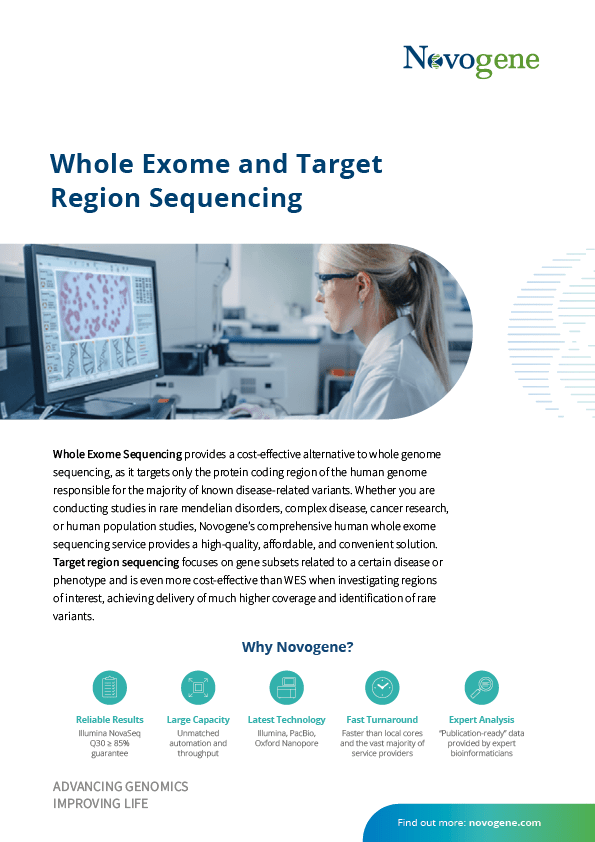
Whole Exome and Target Region Sequencing Service Flyer
Whole Exome Sequencing provides a cost-effective alternative to whole genome sequencing, as it targets only the protein coding region of the human genome responsible for the majority of known disease-related variants. Whether you are conducting studies in rare mendelian disorders, complex disease, cancer research, or human population studies, Novogene’s comprehensive human whole exome sequencing service provides a high-quality, affordable, and convenient solution. Target region sequencing focuses on gene subsets related to a certain disease or phenotype and is even more cost-effective than WES when investigating regions of interest, achieving delivery of much higher coverage and identification of rare variants.
On-demand Webinar
Getting Started with Genomics: Next Generation Sequencing Essentials for 2024
This webinar will provide an accessible introduction to NGS principles and its pivotal role in decoding the secrets of DNA. It will explore the basics of DNA sequencing applications and provide insights into the array of technological platforms available, including Illumina, PacBio, and Oxford Nanopore. Whether you’re a beginner or an experienced professional, this webinar is set to offer a foundational understanding of NGS that will enhance your journey with genomic technologies.
The session will also touch upon Novogene’s contributions to the genomics field and detail the expanded services available for European customers that have contributed to this.
Learning Objectives:
- Gain foundational knowledge of NGS principles
- Understand the basics of DNA sequencing applications and technologies
- Learn about recent developments in NGS technology and services.
TRS Specifications: Sample Requirements
| Sample Type | Amount (Qubit®) | Purity |
| Genomic DNA | ≥ 400 ng | A260/280=1.8-2.0 no degradation, no contamination |
| Genomic DNA from FFPE | ≥ 800 ng | Fragments should be longer than 1000 bp |
| cfDNA / ctDNA | ≥ 50 ng | Fragments should be in multiples of 170bp, with no genomic contamination |
TRS Specifications: Sequencing and Analysis
| Platform Type | Illumina NovaSeq 6000 | ||||
| Read Length | Paired-end 150 bp | ||||
| Sequencing depth | Average effective sequencing depth above 200× | ||||
| Standard data analysis |
|
||||
Note: For detailed information, please refer to the Service Specifications and contact us for customized requests.
Novogene Workflow of TRS Service


Featured Publications of TRS Sequencing
-
The Spectrum of mitochondrial genomic variation in parathyroid neoplasms
Endocrine Date: July 2021IF: 21.674DOI: 10.1007/s12020-021-02825-8
-
Journal of HepatologyIDecember Date: 2019IF: 20.582DOI: http://dx.doi.org/10.1016/j.jhep.2019.07.014
-
Genetic Alterations in Esophageal Tissues From Squamous Dysplasia to Carcinoma
Gastroenterology Date: July 2017IF: 18.392DOI: 10.1053/j.gastro.2017.03.033
Data Quality Control
Sequencing Error Rate Distribution
The sequencing error rate is the major confounding factor of precise detection of low-frequency variations by deep sequencing. It determines the quality of the sequencing data. The sequencing error rate is highly associated with the sequencing cycle, escalating towards the end of each read because of the consumption of chemical reagents, which is a common feature of the Illumina high throughput sequencing platform.

Note:
The x-axis represents the position in reads, and the y-axis indicates the average error rate of bases of all reads at a position.
GC Content Distribution
GC content distribution aims to check the potential of AT/GC separation. Sample contamination, sequencing bias, and errors during library preparation can impact on the sequencing results.

Note:
The x-axis represents the position in reads, and the y-axis indicates the percentage of each type of bases (A, T, G, C); different bases can be distinguished by different colors.
SNP and InDel calling, annotation and statistics
Single nucleotide polymorphisms (SNPs), also known as single nucleotide variants (SNVs), constitute the largest class of genetic variants in the genome. Another class of genetic variations includes small insertions and deletions (InDels) which are <50 bp in length.

The number of SNPs/InDels in various genomic regions

The number of different types of SNPs/InDels in coding region
*Please contact us to get the full demo report.
More Research Services
