Introduction to Chromatin Immunoprecipitation Sequencing (ChIP-seq)


ChIP-seq (Chromatin Immunoprecipitation sequencing) is a powerful technique used to study the interactions between proteins and DNA. It allows researchers to map the binding sites of DNA-associated proteins (such as transcription factors, histones, and other chromatin-modifying proteins) across the entire genome. It combines the selectivity of chromatin immuno-precipitation (ChIP) to recover specific protein-DNA complexes, with the power of next-generation sequencing (NGS) to achieve high-throughput sequencing of the recovered DNA.
As protein-DNA complexes are recovered from living cells, ChIP-seq can be used to compare binding sites in different cell types and tissues, or under different conditions. Thus, ChIP-seq is a vital tool for studying gene regulation and epigenetic mechanisms. It can also be combined with other approaches such as RNA-seq and ATAC-seq to gain further insights into the multi-omics of different biological processes.
Applications of Chromatin Immunoprecipitation Sequencing (ChIP-seq):
ChIP-seq is a versatile tool that has broad applications including gene regulation, epigenetics, developmental biology and cancer research. Here are some of the key applications:
- Mapping Transcription Factor Binding Sites: ChIP-seq can be used to map where transcription factors bind to DNA. This can help identify regulatory elements such as promoters, enhancers and silencers that control gene expression.
- Chromatin state mapping: ChIP-seq can be used to map post-translational modifications of histone proteins, such as methylation, acetylation and phosphorylation. These modifications influence chromatin structure and gene expression.
- Studying Chromatin Accessibility and Remodelling: By mapping histone modifications and transcription factor binding, ChIP-seq provides insights into chromatin accessibility and chromatin remodelling.
- Understanding Gene Regulation in Development and Disease: ChIP-seq can be used to study the changes in transcription factor binding and histone modifications during different stages of organismal development and disease progression, such as in cancers.
- Pharmacogenomics: ChIP-seq can be used to study the impact of drugs on transcription factor binding or chromatin modifications, aiding in the discovery of drug targets or understanding drug mechanisms.
Benefits of Novogene’s ChIP-seq service:
- Extensive Experience: Novogene has extensive experience in conducting ChIP-seq projects and providing comprehensive bioinformatics analysis.
- High-Quality Data: We deliver high-quality sequencing data that meets leading industry standards.
- Bioinformatics Support: We provide comprehensive bioinformatics support and utilize the latest version of the industry-standard MACS2 software to provide you with motif prediction, peak annotation and functional analysis with publication ready figures. Customized bioinformatics support is also available for studies exploring correlations between, for example, ChIP-seq data and gene expression.
- Fast Turnaround Times: Our sequencing labs are in Europe, in Germany and the UK, allowing for reduced shipping times. With our large sequencing capacity and automated and streamlined workflows, we ensure that you receive your data promptly without compromising on quality.
- Customer Service System (CSS): Novogene’s Customer Self Service System (CSS) is an online project management portal that streamlines project management and provides direct access to all your sequencing projects in one place. You can view your sequencing project(s), track their progress, access reports, collaborate with your team members, and obtain other useful information in one place.
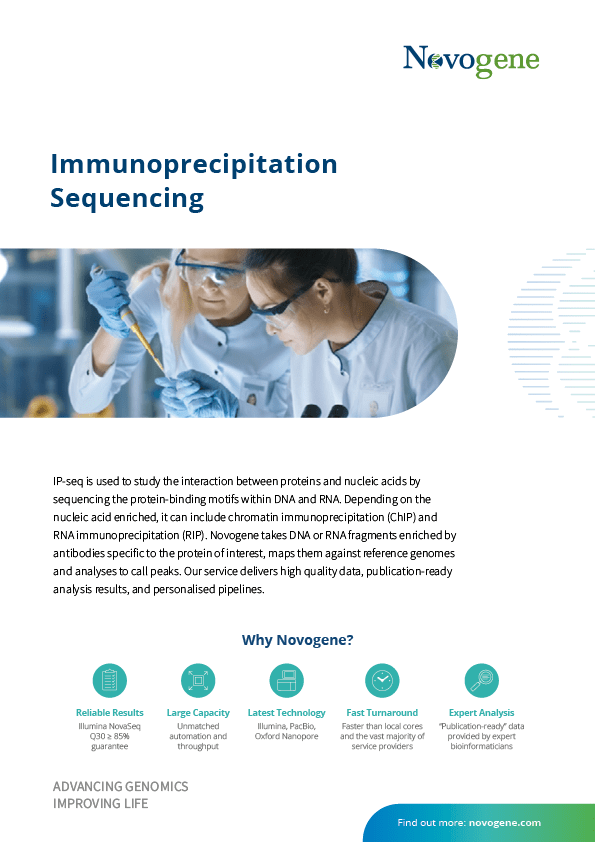
Immunoprecipitation Sequencing Service Flyer
IP-seq is used to study the interaction between proteins and nucleic acids by sequencing the protein-binding motifs within DNA and RNA. Depending on the nucleic acid enriched, it can include chromatin immunoprecipitation (ChIP) and RNA immunoprecipitation (RIP). Novogene takes DNA or RNA fragments enriched by antibodies specific to the protein of interest, maps them against reference genomes and analyses to call peaks. Our service delivers high quality data, publication-ready analysis results, and personalised pipelines.
On-demand Webinar
A Beginner’s Guide to Next Generation Sequencing Solutions for Epigenetics Research
In this webinar, we will showcase Novogene’s diverse sequencing solutions for epigenetics research, including techniques to detect DNA methylation such as Whole Genome Bisulphite Sequencing and EM-seq, determining chromatin accessibility using ATAC-seq, and studying histone modifications (e.g., ChIP-seq), among others. We will delve into the underlying principles of these technologies, explore their various applications, and outline the workflows and analysis pipelines used to achieve comprehensive epigenetic insights.
We will talk about myriad microbial sequencing options such as microbial whole genome sequencing, metagenomics, and metatranscriptomics. We will also discuss recent advances in the field such as the applications of long-read sequencing and highlight Novogene’s diverse microbial sequencing solutions to aid your research.
Learning Objectives:
- Discover sequencing solutions tailored for epigenetics research
- Understand the principles and applications of the various NGS solutions for epigenetics research
- Gain insight into the workflows and bioinformatics analysis pipelines of Novogene’s epigenetics solutions.
ChIP-seq Specifications: DNA Sample Requirements
| Sample Type | Required Amount | Volume | Fragment Size |
| Enriched DNA Sample | ≥ 20 ng | ≥ 12 μL | Main peak within 100 bp and 500 bp |
Note: We accept purified/enriched DNA samples only. Sample amounts are listed for reference. Please don’t hesitate to reach out to us for detailed information or customized requests.
ChIP-seq Specifications: Sequencing & Analysis
| Sequencing Platform | Illumina NovaSeq X Plus |
| Read Length | Pair-end 150 bp |
| Sequencing Depth | ≥ 20 million read pairs per sample for the species with reference genome |
| Standard Data Analysis |
|
Note: Sequencing parameters and analysis contents displayed are only for reference. Please contact us for detailed information and customized requests.
Project Workflow of Novogene’s ChIP-seq service:
We accept purified/enriched DNA samples and follow Novogene’s ChIP-seq service which comprises of four steps, including sample QC, DNA library preparation, Illumina PE150/SE50 sequencing and data analysis using bioinformatics pipelines. From DNA sampling to sequencing the library, every step can potentially impact the quality and quantity of data output, directly influencing the results of the subsequent bioinformatics analysis. Novogene performs rigorous checks at every stage, including sample quality control, library quality control and sequencing data quality control, to ensure the highest quality, accuracy and reliability of the sequencing data delivered to our customers.



Featured Publications using Novogene ChIP-seq Service
ChIP-seq provides genome-wide profiling of DNA targets for histone modification, transcription factors, and other DNA-associated proteins. Novogene provides high-quality sequencing and comprehensive bioinformatics analysis, including peak calling, motif analysis, peak annotation, differential analysis, and related functional analysis. We summarize a publication list with Novogene ChIP-seq service.
-
Long noncoding RNAs underlie multiple domestication traits and leafhopper resistance in soybean
Nature GeneticsIssue Date: 4 April 2024IF: 30.8DOI: 10.1038/s41588-024-01738-2
-
Parental histone transfer caught at the replication fork
NatureIssue Date: 6 March 2024IF: 64.8DOI: 10.1038/s41586-024-07152-2
-
Activation of recombinases at specific DNA loci by zinc-finger domain insertions
Nature BiotechnologyIssue Date: 31 January 2024IF: 46.9DOI: 10.1038/s41587-023-02121-y
-
Cycles of satellite and transposon evolution in Arabidopsis centromeres
NATUREIssue Date: 17 May 2023IF: 69.504DOI: 10.1038/s41586-023-06062-z
-
Activation of recombinases at specific DNA loci by zinc-finger domain insertions
NATURE BIOTECHNOLOGYIssue Date: 31 January 2024IF: 46.9DOI: 10.1038/s41587-023-02121-y
-
Primate-specific ZNF808 is essential for pancreatic development in humans
NATURE GENETICSIssue Date: 16 November 2023IF: 30.8DOI: 10.1038/s41588-023-01565-x
-
Endothelial Notch1 signaling in white adipose tissue promotes cancer cachexia
Nature CancerIssue Date: 25 September 2023IF: 22.7DOI: 10.1038/s43018-023-00622-y
-
Nature CommunicationsIssue Date: 19 April 2023IF: 17.694DOI: 10.1038/s41467-023-37805-1
-
Nature PlantsIssue Date: 24 April 2023IF: 17.352DOI: 10.1038/s41477-023-01400-5
-
SET Domain–Containing Protein 4 Epigenetically Controls Breast Cancer Stem Cell Quiescence
Cancer ResearchIssue Date: 2019IF: 9.727DOI: 10.1158/0008-5472
-
Zscan4c activates endogenous retrovirus MERVL and cleavage embryo genes
Nucleic acids researchIssue Date: 15 July 2019IF: 11.501DOI: 10.1093/nar/gkz594
-
Nature communicationsIssue Date: 18 January 2019IF: 12.121DOI: 10.1038/s41467-018-08277-5
-
Cancer ResearchIssue Date: 2018IF: 9.727DOI: 10.1158/0008-5472
-
Targeting Epigenetic Crosstalk as a Therapeutic Strategy for EZH2-Aberrant Solid Tumors
cellIssue Date: 20 September 2018IF: 38.637DOI: 10.1016/j.cell.2018.08.058
Distribution of MAPQ

Plot of Strand Cross Correlation

Distance Distribution of Peaks to TSS

Motif Analysis

Peak Distribution in Functional Gene Regions

Diagram of GO Enrichment

KEGG Enrichment Scatter Plot

